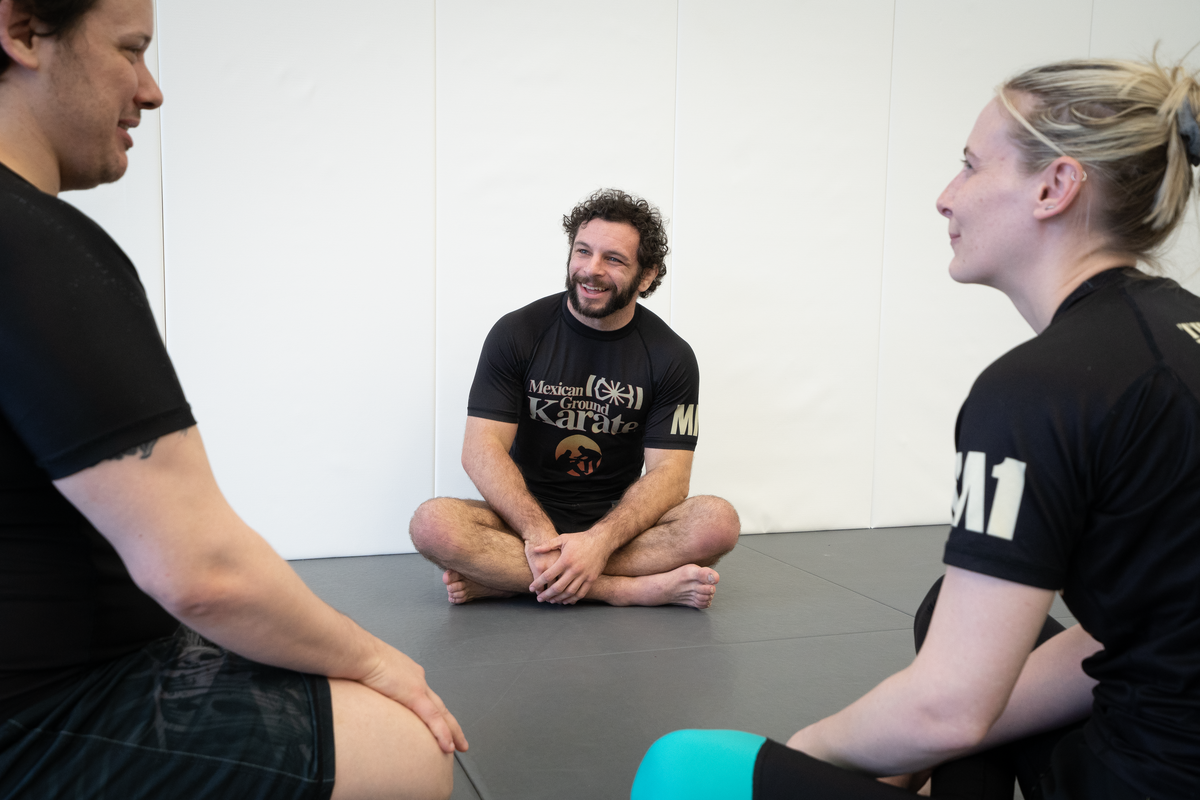
Learn the core positions, escapes, and safe training habits that help beginners progress fast and enjoy every class.
Starting Jiu Jitsu can feel like learning a new language with your whole body: unfamiliar grips, new ways to move, and a lot of positions with names you have never used in daily life. The good news is that beginners improve quickly when training follows a clear fundamentals roadmap, and that is exactly how we teach in Green Brook.
This guide breaks down what matters most in your first weeks and months: how to move safely, what the main positions mean, which submissions show up most often, and how to build confidence without rushing. Brazilian Jiu-Jitsu is also booming nationwide, with search interest up more than 100 percent since 2004, so if classes feel more popular than you expected, that is not your imagination.
Why Jiu Jitsu is growing so fast and what that means for beginners
Jiu Jitsu has become one of America’s fastest-growing combat sports, with roughly 750,000 practitioners in the US and millions worldwide. Growth is exciting, but it also raises the stakes for smart onboarding, because more people on the mats means more mismatched experience levels if a program is not structured carefully.
We keep our beginner pathway focused on fundamentals first: positional control, clean escapes, and “tap early” habits. That approach matters because injury data in grappling is real. Around 59 percent of athletes report injuries within a six-month period, and emergency department visits tied to BJJ injuries have risen over the last decade. Beginners tend to get hurt more in training than in competition, so our priority is making your first phase sustainable.
Your first objective: learn positions before submissions
Most beginners want to learn submissions right away, and we get it. But in practice, your success comes from understanding where you are and what you are trying to achieve in that position. A submission is usually the final step after you win space, posture, angles, and control.
The major positions you will hear in class
We teach positions as a map. Once you can name where you are, you can make calmer decisions.
• Guard: you are on bottom using your legs and frames to control distance and off-balance your partner
• Side control: you are on top pinning torso and hips while preventing guard recovery
• Mount: you are on top straddling the hips with strong control and high finishing potential
• Back control: you are behind your partner with hooks and seatbelt style control, often the safest finishing position
• Turtle and front headlock: transitional positions where wrestling-style control and pressure matter a lot
This positional mindset also matches what we see at high levels. Even in elite no-gi events, wrestling takedowns and controlling sequences dominate successful actions, and chokes account for most finishes. Fundamentals are not “basic” in a dismissive way. Fundamentals are what keep working.
Movement fundamentals: the hidden engine of progress
Before you worry about fancy techniques, you need reliable movement. If you cannot move your hips, you cannot escape, retain guard, or set up attacks. In our beginner classes, we spend real time on these patterns because they pay you back immediately.
Week 1 essentials: how to move on the mat
Expect to practice these early and often:
1. Shrimping: hip escape used to create space and recover guard
2. Bridging: explosive hip lift used to off-balance and initiate escapes
3. Technical stand-up: a safe way to get up without giving easy access to your legs
4. Breakfalls: reducing impact when you get taken down or swept
5. Base and posture: staying balanced so you are harder to sweep and submit
If you show up consistently, these stop feeling like drills and start feeling like tools you can grab under pressure.
Escapes: the fastest way to feel confident
Escapes are the superpower of beginner Jiu Jitsu. When you know you can get out, you relax. When you relax, you learn faster. We teach escapes as a sequence: frames first, then hips, then recover a safer position.
Escape priorities we build into training
• From mount: protect your neck and arms, create a frame, bridge to off-balance, then shrimp to recover guard
• From side control: frame at the neck and hip, move your hips away, then rebuild guard with your knees
• From back control: hand-fight first, then address hooks and rotate to a safer angle
• From bad headlock positions: posture and framing to relieve pressure before turning in or clearing grips
You do not need to “muscle out.” You need timing and structure. That is why we teach you to use your skeleton, not your biceps, to create space.
Guard basics: closed guard, open guard, and why both matter
Guard is where beginners often spend the most time, especially in adult Jiu Jitsu in Green Brook, NJ where many students start for fitness and self-defense and want a methodical pace. We treat guard as a system for controlling distance and setting up sweeps or submissions.
Closed guard: your early home base
Closed guard is a strong learning position because it slows things down. You can practice posture control, breaking balance, and chaining simple attacks without chasing speed.
Early goals in closed guard include:
- breaking posture with grips and angle changes
- learning hip movement to create a finishing angle
- attacking with simple combinations like collar ties, arm control, and off-balancing
Open guard: where modern grappling lives
Open guard introduces distance management with your feet, shins, and hooks. It also connects naturally to standing exchanges, which are becoming more important as wrestling emphasis grows in the sport.
We focus on open guard concepts that translate across styles: inside position with your legs, strong frames, and returning to guard quickly if your partner starts passing.
Guard passing: how we teach you to get on top safely
Passing guard is not just “getting around the legs.” It is controlling hips, winning inside space, and preventing re-guard. Our passing curriculum starts with posture and pressure principles that keep you safe from sweeps and triangles while you learn.
We introduce beginner-friendly passes that work for different body types, including:
- knee slice style entries where you control the near hip and crossface
- pressure passing principles where you flatten hips and remove frames
- basic toreando style movement to redirect legs and secure side control
We also teach you what not to do: reaching with your arms while your posture collapses. That habit is how people get caught early and feel like Jiu Jitsu is “too confusing,” when it is really just a missing detail.
Submissions beginners should understand first (and why chokes lead the list)
Submissions are part of the fun, but we teach them responsibly. We want you to learn finishing mechanics, not just copy a shape with your arms. At elite levels, chokes dominate. At ADCC 2024, about 65 percent of submissions were chokes and about 20 percent were arm attacks. That lines up with what we prioritize for beginners.
High-percentage beginner submissions we teach carefully
• Rear naked choke mechanics from back control, with strong hand-fighting habits
• Cross-collar style choking concepts in the gi, emphasizing posture breaks and angles
• Armbar fundamentals from mount and guard, focusing on controlling the elbow line
• Kimura grip concepts as a control and finishing system, not a “rip and hope” move
We also set expectations. Some submissions are rarer in competition data, like omoplatas with low overall finish rates, but they still teach valuable control and transitions. We teach you the “why” so your learning stays connected.
Gi vs no-gi for beginners in Green Brook
People often ask whether to start with gi or no-gi. We run both, but for many beginners we like using the gi early because it slows scrambles down and makes certain mistakes obvious. The gi also builds grip fighting discipline and posture awareness that carries over to no-gi.
Interestingly, even in elite no-gi, gi backgrounds remain common among champions. That does not mean you must train one way forever. It means fundamentals built with friction and grips can sharpen your decision-making when things speed up.
Safety and injury prevention: how to train hard without training reckless
Jiu Jitsu is a contact sport. We treat safety as a skill you practice, not a slogan. With injury rates significant across the sport and increasing visibility in injury reporting, the best thing a beginner can do is train with patience and communicate clearly.
Our beginner safety rules that actually work
• Tap early and tap clearly, especially on joint locks and neck pressure
• Match intensity to your experience level, not your ego level
• Ask questions between rounds so confusion does not turn into panic movement
• Prioritize clean technique over “winning” during drilling
• Keep your weekly volume realistic: 2 to 3 classes per week is a strong start for most adults
If you train consistently and recover well, your body adapts. Most people feel better within weeks, not worse, because training improves mobility, posture, and overall conditioning when done responsibly.
A realistic beginner timeline: what progress usually looks like
You do not need to be “athletic” to start Jiu Jitsu in Green Brook, NJ. You need consistency and a willingness to be a beginner for a while. Black belt typically takes 10 years or more, but you will notice meaningful changes much sooner.
Here is a practical progression we see often:
- Month 1: you learn to survive, breathe, and recognize positions
- Months 2 to 3: your escapes get sharper and your guard starts to feel like a plan
- Months 4 to 6: you begin chaining techniques and finishing basic submissions
- Month 6 and beyond: you start developing a personal style based on what fits your body
Some students like tracking progress with apps and stats tools. We are fine with that, as long as the focus stays on learning quality movement and decision-making, not chasing numbers.
What to bring to your first class and how to prepare
Getting started is simple. You do not need a closet full of gear. If you are training in the gi, plan for a gi and a belt, plus a rash guard underneath if you prefer. For no-gi, rash guards and grappling shorts are ideal.
A reasonable starter budget for gear is often around 100 to 200 dollars, depending on what you choose. The bigger preparation is sleep, hydration, and arriving ready to learn. If you come in tense, your cardio will feel worse than it is. If you come in curious, you will settle in fast.
Ready to Begin
If you want a beginner roadmap that makes sense from day one, we built our fundamentals-first training to meet you where you are and help you progress without getting overwhelmed. You will learn Jiu Jitsu the way it is meant to be learned: positions, escapes, control, and submissions layered in at the right time.
When you are ready to train in Green Brook with a clear plan and a welcoming room, we would love to help you get started at All in Jiu-Jitsu and keep your progress steady, safe, and genuinely enjoyable.
New to martial arts? Start your journey with a beginner-friendly Brazilian Jiu-Jitsu class at All In Jiu-Jitsu.