
When your workouts feel like a chore, Jiu Jitsu gives you a reason to show up and the energy to keep going.
If you have ever finished a long workday in Green Brook and felt like your motivation got left somewhere between meetings, errands, and the couch, you are not alone. We meet plenty of adults who are not necessarily lazy or out of shape, but who feel drained in a way sleep alone does not fix. The good news is that energy is not just something you either have or do not have. You can train it.
Jiu Jitsu stands out because it is physical, strategic, and social all at the same time. That combination matters. When you walk into class, you are not just burning calories, you are learning, adapting, and solving problems with real people in real time. In our experience, that is where motivation starts to come back, because training feels meaningful, not monotonous.
In this article, we will break down why Jiu Jitsu tends to improve daily energy, sharpen focus, and rebuild the kind of internal drive that carries into work, relationships, and the rest of your week.
The science behind the post-class energy boost
A lot of people expect martial arts to make you tired. And yes, you will work hard. But the surprising part is how often students tell us they leave class feeling more awake than when they arrived.
One reason is neurochemistry. Hard, skill-based training supports the release of brain-derived neurotrophic factor, or BDNF. BDNF is strongly associated with the feel-good, clear-headed effect many people describe after exercise. It is also linked to brain health, learning, and memory, which helps explain why you can feel mentally switched on after a demanding session.
Jiu Jitsu also creates a natural rhythm of intensity and recovery. You might drill a technique, then test it with controlled resistance, then reset and try again. That cycle teaches your nervous system to handle stress, recover quickly, and stay engaged without spiraling into mental fatigue.
Why Jiu Jitsu motivation feels different than gym motivation
Standard fitness plans often rely on willpower. You tell yourself you should go, and then you negotiate with yourself for 20 minutes. With Jiu Jitsu, motivation tends to become more intrinsic, meaning you want to train because it is interesting, satisfying, and social.
Research on grappling athletes supports this. People stick with training when they feel enjoyment, competence growth, and connection. That is exactly what the mat provides. You get immediate feedback, small wins you can measure, and training partners who notice when you show up.
We also see that motivation gets stronger as your skill improves. Early on, you might feel clumsy, which is normal. But as you build a few reliable movements and start recognizing patterns, your confidence increases. That confidence is fuel. It makes you want to train more, which creates more progress, which creates more drive. It is a simple loop, but it is powerful.
Building real resilience that carries into your week
One of the most underrated energy drains is stress. When your mind is constantly running, your body can feel tired even if you have been sitting all day. Jiu Jitsu gives you a structured place to process stress in a productive way.
Experienced practitioners consistently show higher mental strength, self-efficacy, self-control, and resilience compared to beginners. That matters because motivation is not just excitement. Motivation is also the ability to stay steady when you feel pressure, when plans change, or when you are not in the mood.
Training teaches you how to breathe when you are uncomfortable, how to problem-solve when you are behind, and how to keep moving without panicking. Those are mat skills, but they become life skills quickly. We hear it all the time: work stress feels more manageable after a few months of consistent training, not because work changes, but because you change.
Energy you can actually feel: physical conditioning that supports daily life
Jiu Jitsu is a full-body activity with real demands. You push, pull, bridge, grip, balance, and move your weight in ways that most adults do not get from normal routines. Over time, that improves overall conditioning in a way that shows up outside the gym.
Studies point to improvements in cardiovascular function, strength, endurance, flexibility, and anaerobic capacity. Those are technical terms, but the day-to-day effect is simple: your body starts to feel more capable. Stairs get easier. Your posture improves. You are less winded when you have to hustle. You carry yourself differently.
Better conditioning also supports better sleep quality for many adults, which feeds back into energy and motivation. We are not saying Jiu Jitsu fixes everything, but when you move hard and learn something new, your body tends to settle down at night in a healthier way.
Mental clarity: the cognitive side of Jiu Jitsu
Jiu Jitsu is often called physical chess, and while that phrase gets used a lot, it does point to something real. You are constantly making decisions under pressure: where your hands go, how you manage distance, when to move, when to stay patient.
That cognitive load can improve mental acuity. You practice focusing on one task while your heart rate is elevated. You learn to prioritize. You learn to keep thinking when your muscles are tired. For adults who spend all day in front of screens, that kind of focused, embodied problem-solving can feel like a reset.
It is also a healthy break from passive consumption. Instead of scrolling, you are engaged. Instead of absorbing stress, you are doing something with it. That shift alone can bring back a sense of motivation that feels more like momentum than hype.
What adult students in Green Brook typically want, and how we structure training
A lot of adults are not trying to become professional competitors. Most want energy, stress relief, skill development, and a routine that fits real life. That is why adult Jiu Jitsu in Green Brook, NJ needs to be practical and sustainable, not random.
We run classes with structure so you can show up after a long day and not have to guess what is happening. You learn fundamental positions and escapes, you drill with purpose, and you get controlled rounds where you can apply what you learned. We keep the room focused, but welcoming. You should feel challenged, not judged.
Our coaches also pay attention to pacing and progressions. Going hard every day sounds tough, but it is not always smart. Many adults get better results training consistently at a manageable intensity, especially when the goal is long-term energy, not short-term burnout.
A simple weekly training approach for sustained energy
If you want Jiu Jitsu to improve your energy during the workweek, consistency matters more than heroic sessions. We usually recommend starting with a schedule you can actually repeat.
Here is a simple framework we often see work well for adult Jiu Jitsu in Green Brook, NJ:
- Two classes per week to build skill, routine, and recovery without feeling overwhelmed
- One optional third session for drilling or lighter rounds once your body adapts
- At least one full rest day after your hardest session to keep motivation high
- A quick post-class meal and hydration plan so you recover instead of crashing
- A notebook or phone note with one takeaway per class to reinforce progress
This is not the only way to train, but it is a realistic way to turn training into steady energy instead of another stressor.
Why the community factor changes everything
Motivation is easier when you are not doing it alone. The social side of training is not fluff. It is a real driver of consistency, and consistency is what changes energy levels over months, not days.
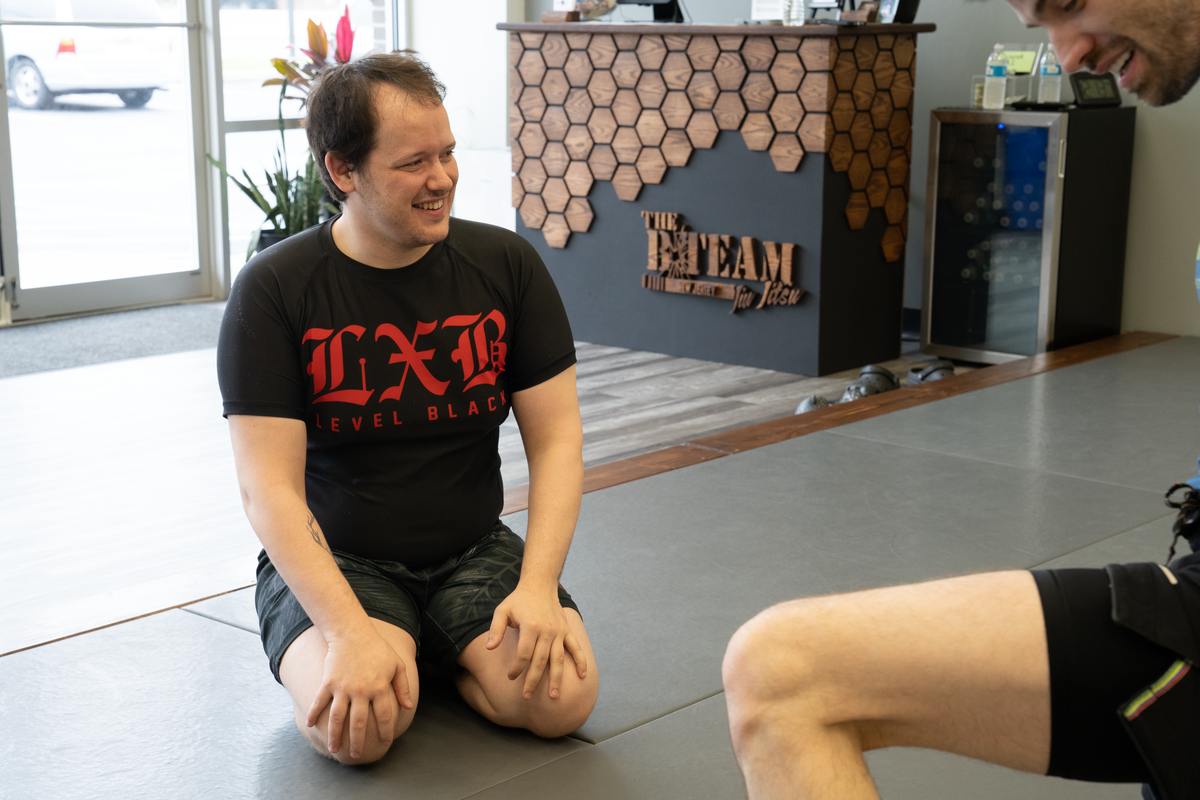
When you train in a room where people learn together, you naturally build accountability. Someone notices when you come in. Someone asks how your week is going. You partner up, you help each other drill, and you end up laughing about the same small struggles, like trying to remember which side your underhook goes on. Those moments matter.
Research supports that social connection in training environments boosts adherence and well-being. In plain language, you are more likely to keep showing up when you feel like you belong, and showing up is where the benefits accumulate.
The confidence effect: competence creates motivation
A major reason adults feel unmotivated is that many activities do not give clear progress markers. You can lift weights for months and still wonder if you are doing it right. With Jiu Jitsu, progress becomes obvious in small, measurable moments.
You might notice you can escape a position that used to trap you. You might stay calm longer during rounds. You might recognize a setup before it happens. Those wins are not imaginary. They are skill, earned through repetition.
As your competence grows, your self-efficacy grows too. That is the belief that you can handle challenges. And when you believe you can handle challenges, you tend to take on more, not less. That is where motivation turns into a habit.
What to expect in your first few classes
If you are new to Jiu Jitsu in Green Brook, NJ, the first class can feel like a lot, and that is normal. New movements, new terminology, close contact, and a different kind of cardio. We keep the learning curve manageable, and we expect beginners to be beginners.
Here is what we focus on early:
1. Basic safety, tapping, and how to train with control so you can learn without unnecessary risk
2. Fundamental positions like guard, mount, side control, and back control so the game starts to make sense
3. Simple escapes and posture concepts that help you feel less stuck
4. Drilling with clear goals so you build timing and confidence
5. Controlled rounds where you can experiment, ask questions, and improve steadily
Most adults feel noticeably more comfortable within a few weeks, especially if you train consistently and do not rush the process.
Take the Next Step
If you want more energy and motivation, you need an activity that challenges your body, engages your mind, and gives you a reason to come back next week. That is what we aim to deliver every time you step on the mat, whether you are starting from scratch or returning to training after years away.
At All in Jiu-Jitsu, we build your progress through structured classes, supportive training partners, and a pace that makes adult training sustainable. If you are ready to see how Jiu Jitsu can change your week, we would love to train with you here in Green Brook.
See firsthand what makes training at All in Jiu-Jitsu special by joining a Jiu-Jitsu class today.