
Jiu Jitsu gives your mind something real to do, not just something else to worry about.
Stress shows up differently for every adult, but in Green Brook it often has a familiar rhythm: long workdays, traffic, screens, family responsibilities, and the feeling that your brain never really powers down. We meet plenty of adults who are doing “all the right things” for wellness, yet still feel keyed up, restless, and a little worn thin. That is exactly why Jiu Jitsu has become one of the most practical stress-relief tools we teach.
What makes Jiu Jitsu different is that it is not passive. You cannot scroll through a class. You cannot half-focus your way through it. You have to be present, because your partner is right there, and the moment you drift, you feel it. For many adults, that becomes the reset: a structured hour where your attention finally lands in one place.
If you are looking for Jiu Jitsu in Green Brook, NJ as a way to decompress, we want you to understand what is actually happening during training, and why it tends to work so well for stress, anxiety, and mental fatigue.
Stress relief that is backed by more than vibes
A lot of stress advice sounds nice but feels hard to apply. Training is different because it creates a repeatable practice, with immediate feedback. Research on Brazilian Jiu Jitsu has found that practitioners tend to manage stress better than sedentary individuals and feel less impacted by everyday stressors. Studies also point to meaningful improvements in anxiety and depression markers, and even reductions in PTSD symptoms in certain populations after consistent training.
We keep this grounded in reality: Jiu Jitsu is not therapy, and it is not a magic switch. But as a structured practice that blends physical exertion, problem-solving, and social connection, it hits multiple stress pathways at once. That is why adults often stick with it when other stress tools fade out after a few weeks.
Why Jiu Jitsu calms your nervous system, even though it looks intense
On the surface, Jiu Jitsu can look like pure chaos: grips, pressure, scrambling, someone trying to control you. Under the hood, it can teach your nervous system a new pattern: stay calm, breathe, solve the problem in front of you.
Physical exertion that actually “finishes” the stress cycle
A big part of stress is unfinished energy. You sit in meetings, you hold your posture, you keep your voice steady, and your body never gets to discharge the tension. Training gives you a safe, supervised outlet. You sweat, your heart rate climbs, your muscles work, and afterward your body finally gets the signal that the threat is over.
Regular practice also affects brain chemistry and stress response systems. Research suggests Jiu Jitsu training can increase beneficial neurochemicals like serotonin and oxytocin while reducing stress hormones over time. In plain terms, consistent classes can make your baseline feel steadier.
Mental focus that blocks rumination
Adults often tell us their stress is not one problem, it is the mental loop. Jiu Jitsu interrupts that loop because you have to track posture, balance, grips, timing, and space. You cannot overthink tomorrow’s email when you are trying to keep your elbows in and protect your neck.
And it is not just distraction. It is skill-based attention. Your brain learns to focus on what is controllable, right now, which is a habit that carries over into work and home life.
Controlled discomfort that builds resilience
One reason adult Jiu Jitsu in Green Brook, NJ resonates is that it offers a safe form of pressure. You experience challenging situations (being pinned, feeling stuck, losing a position), but you also learn technical ways out. Over time, your body stops treating every uncomfortable moment as an emergency.
Researchers have described the immersive, repetitive nature of training as similar to exposure work in a controlled environment. You meet stress triggers in small doses, you learn to regulate your breathing, and you practice staying thoughtful under pressure. That is a powerful skill for adults who spend most of their week in invisible stress.
The stressors adults bring to the mats, and how training meets them
We work with adults across different schedules and backgrounds, and the stress themes tend to repeat. Here is how Jiu Jitsu often helps in a very practical way.
Work stress and decision fatigue
If your day is full of decisions, training can feel like a relief because the rules are clear: position before submission, protect yourself, improve one detail at a time. You still make decisions, but they are simpler and more immediate. That kind of clarity is calming.
Parenting, caregiving, and being “on” all the time
Caregiving stress is constant, and it is easy to forget what it feels like to have time that is yours. Training becomes an appointment that is not negotiable, and that matters. You get to move, breathe, learn, and be around adults who are focused on something constructive. Many students say they leave class more patient at home, which is a win that shows up quickly.
Social stress and isolation
Stress gets heavier when you carry it alone. Jiu Jitsu is inherently social, but not in a forced, awkward way. You pair up, you drill, you learn names, you gradually become part of the room. That sense of community is one of the most underrated benefits, and research consistently highlights it as part of why practitioners report better overall well-being.
What a typical class feels like when you are new
Walking into a martial arts class as an adult can feel intimidating, mostly because adults do not like being “new” at things. We get that. Our job is to make the learning curve realistic and safe.
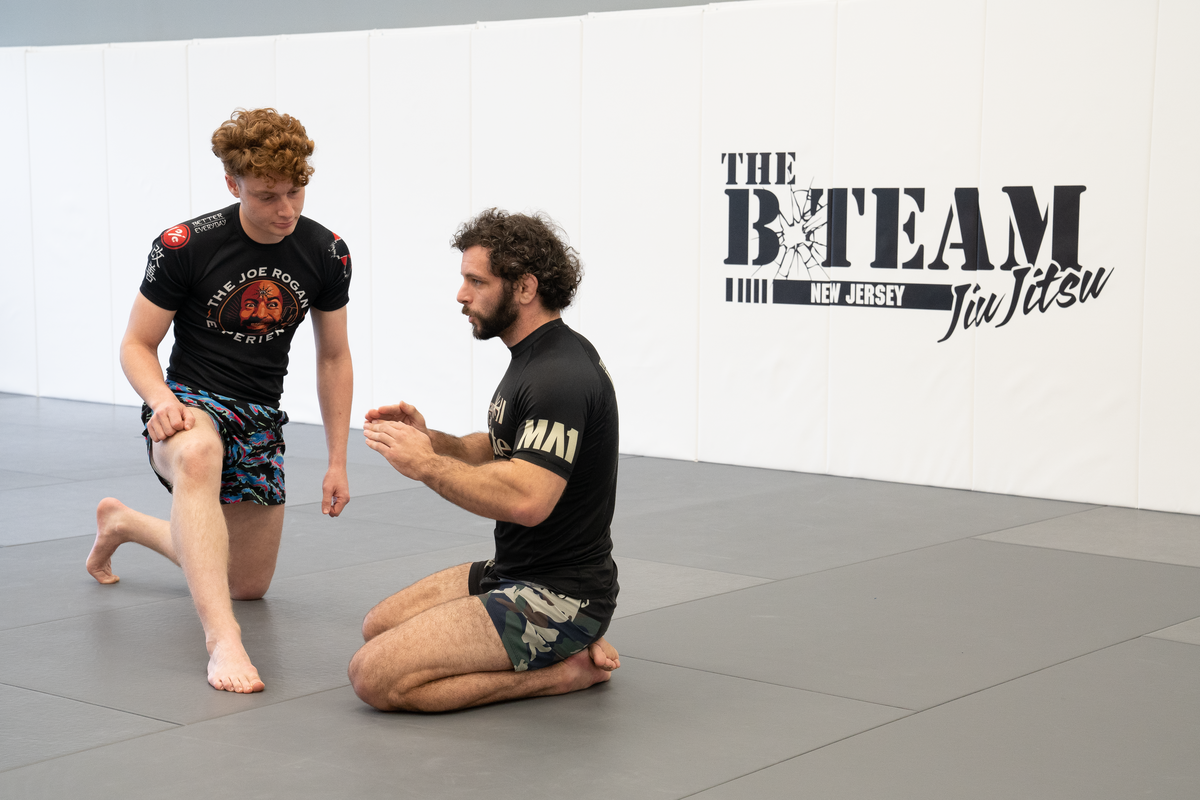
A typical class usually includes a warm-up that supports movement you will actually use, technique instruction with clear steps, drilling with a partner, and optional live rounds (sparring) depending on the class and your level. You will sweat. You will mess up details. You will also get coached through it, and you will improve faster than you expect.
What surprises most beginners is the tone: focused, but not hostile. You are training with partners, not fighting enemies. That difference matters for stress relief, because you can push yourself without feeling threatened.
Why progress in Jiu Jitsu reduces stress outside the gym
Adults often start for stress relief, then stay because the personal development becomes obvious. Jiu Jitsu gives you measurable progress, and that can be rare in adult life. You can feel stuck at work or overwhelmed at home, but on the mat you can point to something concrete: your escape is cleaner, your balance is better, your breathing is calmer in bad positions.
Over time, that shows up as confidence, but not the loud kind. It is the quiet confidence of knowing you can deal with pressure without panicking. Research has linked training to increases in self-control and resilience, and reductions in aggression, along with improved life satisfaction. Those are not abstract outcomes. Those are the things that make daily life feel less jagged.
A simple way to think about Jiu Jitsu as stress training
We sometimes explain Jiu Jitsu as a practice of learning control in stages. If you want a simple mental model for how it helps with stress, here is a common progression we see:
1. You learn to breathe and stay safe when things feel unfamiliar
2. You learn basic positions so you stop feeling lost
3. You learn escapes so you trust you can recover from bad moments
4. You learn control so you stop relying on strength and urgency
5. You learn submissions as problem-solving, not panic-finishing
This progression is why Jiu Jitsu often changes how you handle pressure at work or at home. You train your response, not just your body.
Getting started as an adult in Green Brook, NJ without overthinking it
A lot of adults delay starting because they assume they need to get in shape first, or they worry about injuries, or they feel like they will be behind everyone else. We would rather you start where you are, because the program is designed to build you up progressively.
Here are a few practical expectations that make the first month smoother:
• Show up consistently, even if you feel awkward at first, because familiarity reduces stress quickly
• Focus on learning positions and defense before chasing “wins” in sparring
• Tap early and communicate, because safety and longevity matter more than ego
• Ask questions, because adults learn faster when they understand the why
• Expect ups and downs, because progress in Jiu Jitsu is real, but it is not linear
If your goal is stress relief, you do not need to train like a competitor. You need consistent practice, smart pacing, and a room where you can learn without feeling judged.
Ready to Begin
If stress has been living in your shoulders, your sleep, or your attention span, Jiu Jitsu can be a surprisingly direct way to interrupt that pattern. The training demands presence, teaches calm under pressure, and gives you a community that understands what it means to work on yourself one class at a time.
We built adult programs that fit real schedules in Green Brook, and we keep the environment focused, supportive, and practical. When you are ready, All in Jiu-Jitsu is here to help you turn training into a healthier routine that actually sticks.
Experience how Jiu-Jitsu builds resilience and discipline by joining a class at All in Jiu-Jitsu.