When your mind feels loud and your body feels tense, training gives you a quiet, practical reset.
Stress is sneaky. It shows up as tight shoulders on the drive home, an overactive brain at 2 a.m., or that short fuse you wish you didn’t have. In Green Brook, a lot of us juggle long commutes, demanding jobs, and family responsibilities that never really clock out. We built our Jiu Jitsu training experience around a simple goal: help you feel better in your body and steadier in your mind, week after week.
Jiu Jitsu works for stress relief because it’s immersive. When you’re learning how to move, breathe, and solve a problem in real time, your attention has a place to land. You get a full-body workout, but you also get something rarer: a mental break that feels earned, not forced.
Over the last few years, research has started to catch up with what practitioners report. Brazilian Jiu-Jitsu training has been linked to meaningful improvements in anxiety, depression, and markers associated with PTSD, and reviews describe grappling as a promising resilience-building public health tool when trained responsibly. We take that seriously in how we coach, how we structure class, and how we welcome new students into the room.
Why Stress Relief From Jiu Jitsu Feels Different
Most “stress management” advice is passive: sit, breathe, try to calm down. That can help, but it doesn’t always match real life. Our approach is active. You learn how to stay functional while your heart rate climbs and your comfort zone gets challenged, then you bring that skill back to daily life.
In Jiu Jitsu, you practice being uncomfortable in a controlled way. You feel pressure, you work for space, you make decisions, and you learn that panic isn’t useful. That experience is a form of exposure that can build resilience over time, especially when you train consistently and have a supportive training environment.
Just as important, the training is technical. Because leverage and timing matter more than brute strength, you can make progress without having to “win” every moment. That reduces the ego-stress loop that burns people out in other kinds of fitness.
The Science Behind Calm: What Happens in Your Body
Stress is partly chemistry. When you’re overloaded, cortisol and adrenaline can run the show. Training doesn’t erase hard days, but it can change how your body processes them. Exercise supports endorphin release, improves sleep quality, and helps regulate metabolism and cardiovascular health, all of which influence mood and recovery.
Recent trends in research on grappling and martial arts also point to shifts in neurotransmitters and hormones associated with emotional regulation and connection, including increased serotonin and oxytocin and reduced stress responses over time. While the science is still developing and needs more long-term data on training frequency and experience level, the direction is encouraging.
On the mat, you’ll notice it in plain language: after class, your breathing is deeper, your mind is quieter, and you feel like you used your energy the way it was supposed to be used.
Your Nervous System Learns a New Pattern
One of the most useful skills we coach is learning to downshift. If you tense everything, you gas out. If you hold your breath, you make bad choices. So we cue relaxed movement, steady breathing, and efficient frames and escapes. That isn’t just athletic advice, it’s nervous system training.
Over time, you build a body memory of staying calmer under pressure. That tends to show up off the mat, too: a stressful meeting feels less personal, traffic feels less insulting, and you recover faster when the day goes sideways.
Jiu Jitsu as Moving Mindfulness (Without the Awkwardness)
Not everyone enjoys sitting still. Some people try meditation and simply end up thinking about emails. Jiu Jitsu gives you mindfulness with a job to do. You have to pay attention to grips, posture, weight shifts, and timing. Your brain can’t multitask the way it usually does, because the feedback is immediate.
We also like that the mindfulness is practical. You’re not pretending stress doesn’t exist. You’re learning how to function inside it, then getting better at it.
A typical class includes skill instruction, drilling, and live rounds scaled to experience. That structure creates a rhythm: focus, effort, reset, repeat. Many students tell us it’s the first time all day their attention isn’t being pulled in five directions.
The Social Side of Stress Relief: Community That Actually Helps
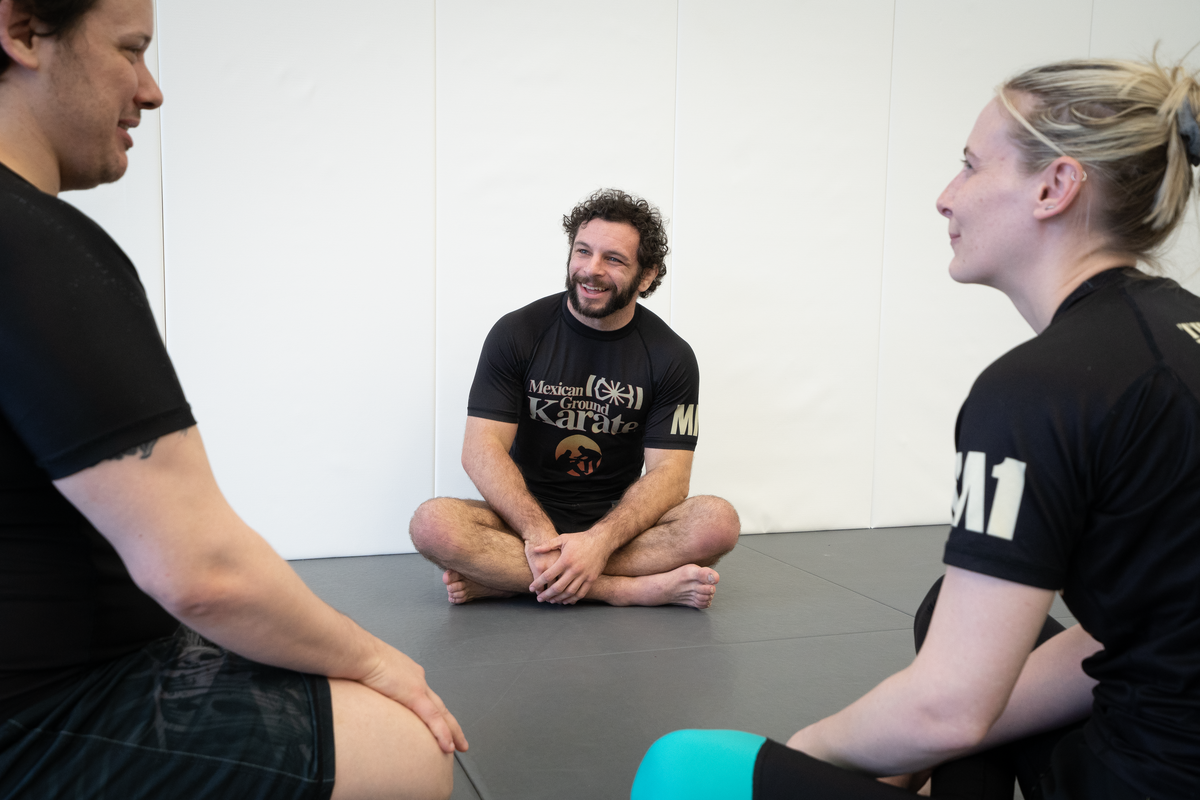
Stress is amplified by isolation. One reason adult Jiu Jitsu in Green Brook, NJ can be so effective is that you don’t train alone. You partner up, you learn names, you laugh a little when things go wrong, and you realize you’re not the only person trying to manage life.
Studies on Jiu Jitsu and psychosocial outcomes describe benefits like improved self-control, resilience, respect, perseverance, and self-confidence, along with reductions in certain externalizing behaviors and psychopathological symptoms. That makes sense in a gym setting where you practice cooperation, boundaries, and accountability every single session.
And here’s a small detail that matters: you get appropriate physical contact in a safe, coached environment. For many adults, that’s rare. When it’s done respectfully, it can be grounding.
From Desk Stress to Mat Confidence: What Many Adults Experience
A lot of adults walk in thinking they need to “get in shape first.” We’d rather you don’t. Jiu Jitsu is how you get in shape, and more importantly, how you get more capable.
In the first few weeks, the biggest change is usually mental. You start to recognize patterns: when you tense up, when you rush, when you freeze. Then you get tools to change those patterns. Small wins stack fast, like escaping a tight position, remembering a sequence, or staying calm long enough to work a sweep.
Over a few months, the confidence becomes quieter and more stable. It’s not loud bravado. It’s the simple knowledge that you can learn hard things, stay present, and keep going.
How Our Adult Program Supports Stress Relief in Green Brook, NJ
We coach stress relief through structure, not hype. Our adult program is designed for real schedules and real bodies, including beginners in their 30s and 40s who want a smart challenge without feeling reckless.
What you can expect from our adult classes
• Clear instruction with a technique-first approach, so you learn leverage and positioning instead of relying on speed or strength
• Progressive training that starts with fundamentals and builds toward more complex problem-solving
• Partner work that emphasizes safety, communication, and controlled intensity
• A welcoming environment where you can ask questions without feeling like you’re “behind”
• Training sessions that leave you tired in a good way, not crushed for days
If you’re looking for adult Jiu Jitsu in Green Brook, NJ because your stress levels feel too high, this structure matters. You want consistent challenge, but you also want to walk out feeling better than you walked in.
A Practical Timeline: When You’ll Notice Changes
Stress relief is both immediate and cumulative. You can feel better after one class, but the lasting benefits show up when you train consistently.
Here’s a realistic way to think about it:
1. After 1 to 3 classes, you’ll usually notice a mood lift, a calmer mind for a few hours, and a “good tired” feeling
2. After 3 to 6 weeks, sleep often improves, and daily stress feels less sticky because you’ve had regular physical outlets
3. After 2 to 4 months, resilience becomes noticeable: you recover faster from setbacks and feel more confident under pressure
4. Over 6 months and beyond, many students report stronger emotional regulation, improved fitness markers, and a steadier self-image
We generally recommend training 2 to 3 times per week for stress relief without burning out. More can be great, but consistency beats intensity, especially when life is busy.
Safety, Consent, and Control: The Hidden Stress Reducers
Feeling safe is part of calming down. We keep training productive by setting expectations around tapping, respecting the tap immediately, and communicating with partners. If you have an old injury, we want to know. If a position feels claustrophobic, we can scale how you train while you build comfort.
That safety culture also supports mental health benefits for people in high-pressure jobs, including veterans and first responders. Research and field experience both suggest grappling can help reduce PTSD symptoms and depression while sharpening decision-making under pressure. We coach that pressure with care: enough to learn, not so much that you dread coming back.
Leadership and Decision-Making Under Pressure
Stress often makes people feel powerless. Jiu Jitsu pushes the opposite direction. You learn to diagnose a problem, pick a response, test it, and adjust. That’s decision-making training. It also builds emotional intelligence, because you’re constantly reading balance, posture, intention, and timing.
This is one reason Jiu Jitsu in Green Brook, NJ fits so well for professionals who spend all day thinking and reacting. On the mat, you get immediate feedback and a clear path to improvement. That clarity is relieving.
A small suggestion we give many adults: track your training in a notebook. Write down one technique you learned and one moment you stayed calm. It sounds simple, but it makes progress visible, and visible progress lowers stress.
Take the Next Step With All in Jiu-Jitsu
If you want a stress reset that strengthens your body and steadies your mind, our training is built for exactly that. At All in Jiu-Jitsu, we use Jiu Jitsu to help you develop calm under pressure, better sleep, stronger fitness, and a community that makes consistency easier.
You don’t have to be “tough” to start. You just need a willingness to learn, show up, and let the process work, one class at a time at All in Jiu-Jitsu.
Strengthen both your body and mind through consistent Jiu-Jitsu training at All in Jiu-Jitsu.